
Sagene, Oslo: Still One of the World's Coolest Neighbourhoods — Here's What's New
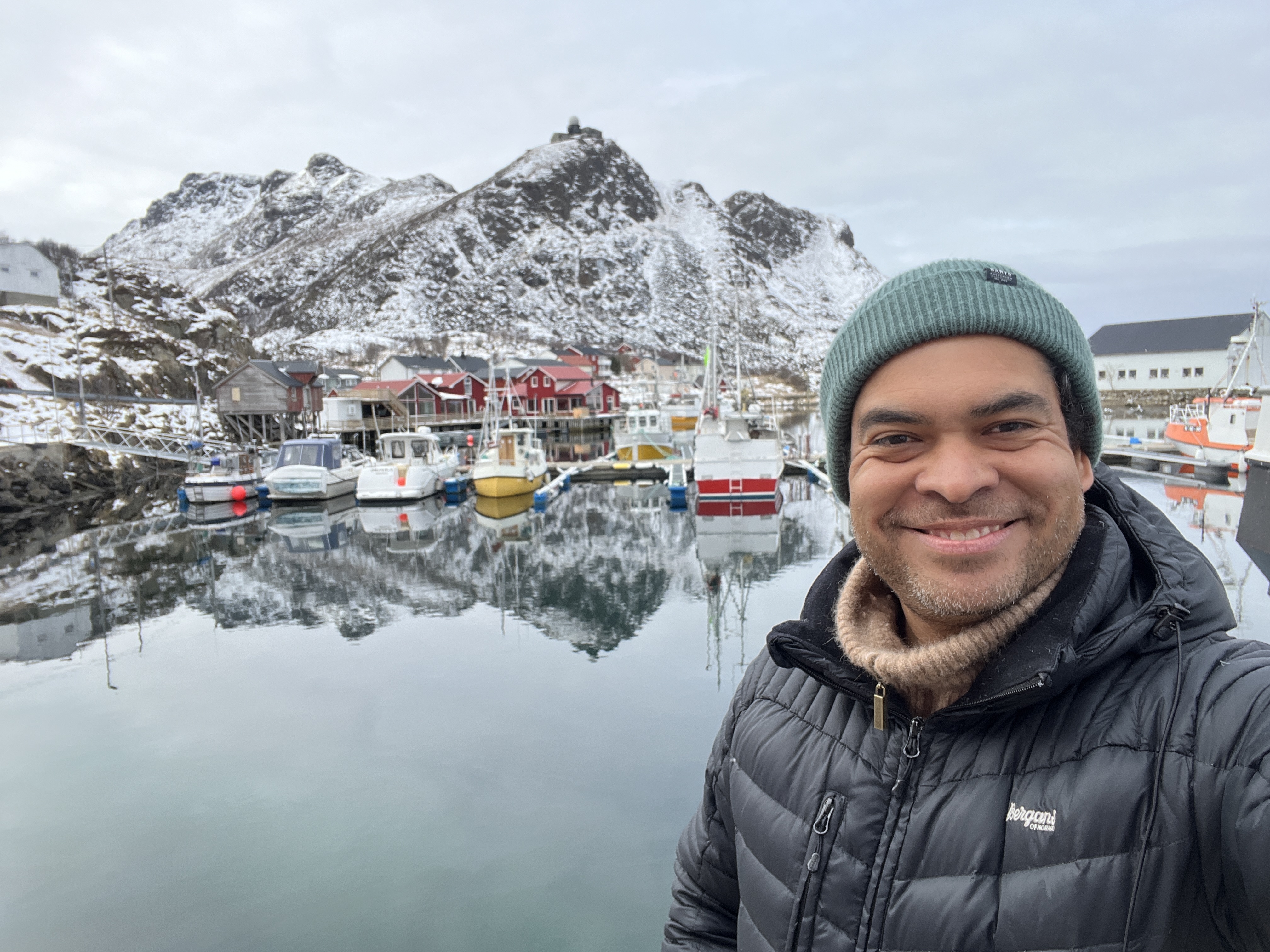
And yes, I had a little something to do with it.

In late 2019, I moved to Oslo. A few months later, the world stopped.
Like everyone else, I spent the spring of 2020 navigating the strange new reality of a pandemic lockdown — the cancelled trips, the closed restaurants, the uncertain future for anyone working in travel. But Oslo, to its credit, remained walkable. And with a lot fewer clients to respond to — both in Norway and back in Brazil — I did something I might never have done otherwise: I explored every single neighbourhood in the city on foot and by public transport, slowly and without an agenda.
It took months. It was one of the best things that ever happened to my understanding of Oslo.
Throughout 2020 and well into 2021, I walked streets I had no reason to visit, stopped in cafés I'd passed without noticing, sat on benches along the Akerselva on autumn afternoons when the light was perfect and the city felt like mine. And in all that time, one neighbourhood kept calling me back: Sagene.
It didn't have the sophistication of Frogner or the self-conscious coolness of Grünerløkka. It wasn't on any tourist map I'd seen. It was just a neighbourhood — a real one, with a character shaped by its working-class roots and the river that once powered the city, with an independent café on every corner and a community that seemed completely indifferent to being discovered. To me, an outsider still learning what Oslo meant, that felt like the most authentic thing in the city.
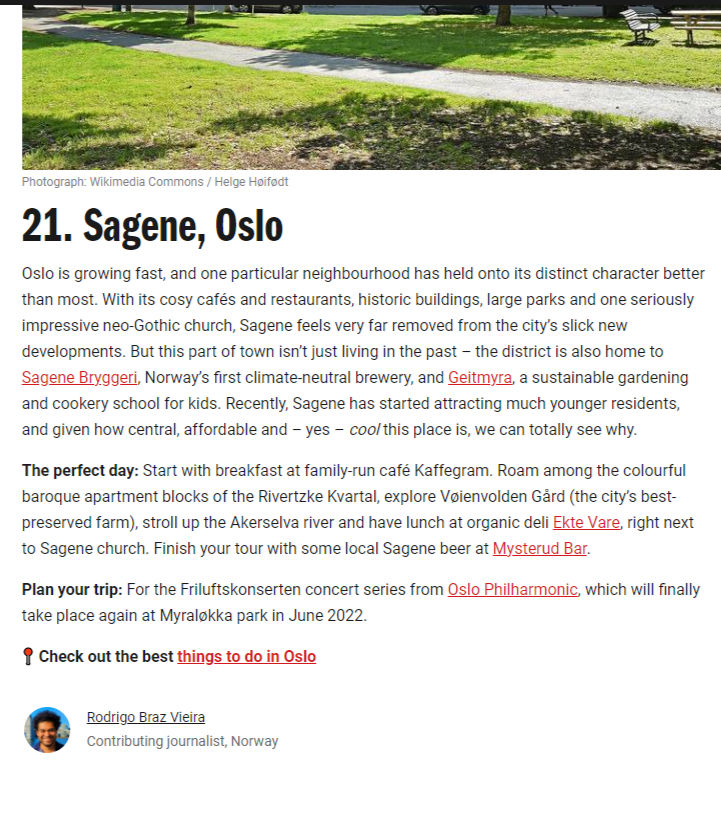
So when Time Out Magazine asked me to write about what I considered the coolest neighbourhood in Oslo, I had no hesitation. I wrote about Sagene.
When the list came out in 2021 — with Sagene ranked 21st among the 49 coolest neighbourhoods in the world — the Norwegian press was, to put it politely, surprised. Nobody had expected this. Not Frogner. Not Grünerløkka. Sagene. I remember the reaction with a certain quiet satisfaction.
A few years on, the neighbourhood has continued to evolve. Some places have changed, new ones have arrived, and the energy that first caught my attention has only settled deeper into the streets. Here's what's new — and what's worth going back for.
Why Sagene, Oslo Is One of the Coolest Neighbourhoods You'll Ever Visit
Built along the Akerselva river, Sagene grew up around the textile mills and factories that drove Oslo's 19th-century industrial revolution. The workers who lived here helped build the labour movement that would eventually shape Norway's welfare state. The old factory buildings still line the river, repurposed now into studios, offices, and cultural spaces — the industry is gone, but the bones of it remain.
What Sagene had — and still has — is something increasingly rare in any European capital: a neighbourhood that is central, affordable, and genuinely local. It has never felt like it was performing anything.
What's New in Sagene Since 2021?

Mjøl Bakeri — The Café That Replaced Kaffegram
The original Time Out piece opened with breakfast at the family-run Kaffegram. That café is gone now — but in its place has come something arguably better. Mjøl Bakeri (the name means simply "flour") has taken root in Sagene and expanded into a small chain of five locations across Oslo, without ever quite feeling like a chain.
Founded by baker Nils-Olav Heggdalsvik after his earlier project Kveitemjøl, Mjøl has built a devoted following on the strength of its pistachio knots, morning buns, almond croissants, and sourdough loaves — all made with the kind of obsessive craftsmanship that resists mass production. Google rates the Sagene branch 4.7. Reviewers use words like "pastry heaven." The coffee is excellent, the atmosphere is cosy, and the space fills quickly on weekend mornings.
Arrive early.
🌐 mjol.no · 📸 @mjolbakeri
Rivertz — A Wine Bar with Art on the Walls
The most exciting recent addition to the neighbourhood is Rivertz, a wine bar and gallery that opened in early 2025 in the Rivertzkvartalet and has already become one of Sagene's defining spaces.
The idea is exactly what it sounds like: a gallery by day, a wine bar by night, and somehow both at once. The people behind it are two groups who found each other — brothers Fredrik and Kristian, who run the art concepts Too Many Prints and Frameshop Sagene, and four friends (Sigurd, Håkon, Jens, and Erlend) who had been running a pop-up wine bar in the neighbourhood for two years and understood what was missing. The result is a small, warm, colourful space with around 50 wines on the menu (20 by the glass), a focus on European producers with strong environmental profiles, and rotating solo exhibitions by Oslo-based artists — about ten per year. Food is simple and local: Norwegian cheeses, anchovies, pâté, and bread from the neighbouring Mjøl bakery next door.
The gallery is open Monday to Saturday from 11am to 4pm. The wine bar runs Tuesday to Saturday from 4pm to 11pm, and Sunday from 4pm to 10pm. No reservations — drop in.
🌐 rivertz.no · 📸 @rivertzsagene
Jungel Pizza — Where Ekte Vare Once Stood
The organic deli Ekte Vare, featured in the original article, is no longer there. Its address now belongs to Jungel Pizza — a New York–style pizzeria that makes everything from scratch, including its own vegan cashew mozzarella, organic pickled onions, and house-made dressings. I'll admit a personal debt here: during the period I was vegan, Jungel's Sagene branch was a genuine lifesaver. Their plant-based options are not an afterthought — they're central to the whole philosophy. Now with four Oslo locations (St. Hanshaugen, Sagene, Torshov, and Adamstuen), the Sagene branch has become a local institution in its own right.
🌐 jungelpizza.no · 📸 @jungelpizza
Mysterud Bar — The Community Local, Still Going Strong
Mysterud Bar appeared in the original piece and earns its place here again. Founded in 2016 by around forty local Sagene residents — many of whom remembered the Mysterud hardware and ironmonger shop that occupied the space for three generations before it closed — this two-room pub near Sagene Church has remained exactly what it set out to be.
Twelve taps, mostly Norwegian craft breweries with a rotating guest selection. Wooden panels, a cabin-like feel, knowledgeable and friendly staff. Ranked fifth among all bars in Oslo on multiple platforms, and rated 4.6 on Google from over 600 reviews. On warm evenings, the fact that it fills up quickly is the best kind of problem to have.
🌐 mysterudbar.no · 📸 @mysterudbar
The Anchors That Haven't Changed
Sagene Bryggeri is still there — Norway's first climate-compensated brewery, established in 2013 in the historic Hjula Veveri building on the banks of the Akerselva. The commitment to sustainability is genuine: a stated goal of reducing emissions by 30% and offsetting the rest. Their beers are now found in supermarkets and Vinmonopolet across the country, but the best way to try them is at source. The brewery shop at Sagveien 23A is open Thursday to Saturday, and the building itself is worth visiting for its industrial history alone.
Geitmyra matkultursenter for barn continues its work as one of Oslo's most distinctive institutions. Since 2011, this food culture centre for children has been running from the historic Geitmyra farm, teaching thousands of Oslo schoolchildren each year how food grows, how it's made, and why it matters — through three teaching kitchens, an outdoor kitchen, a pedagogical garden, a greenhouse, and chickens in the yard. The concept has since expanded to Kristiansand, Ringsaker, and Tønsberg, but Oslo remains its heart. Open garden days and seasonal events are listed on their website.
🌐 geitmyra.no · 📸 @geitmyra
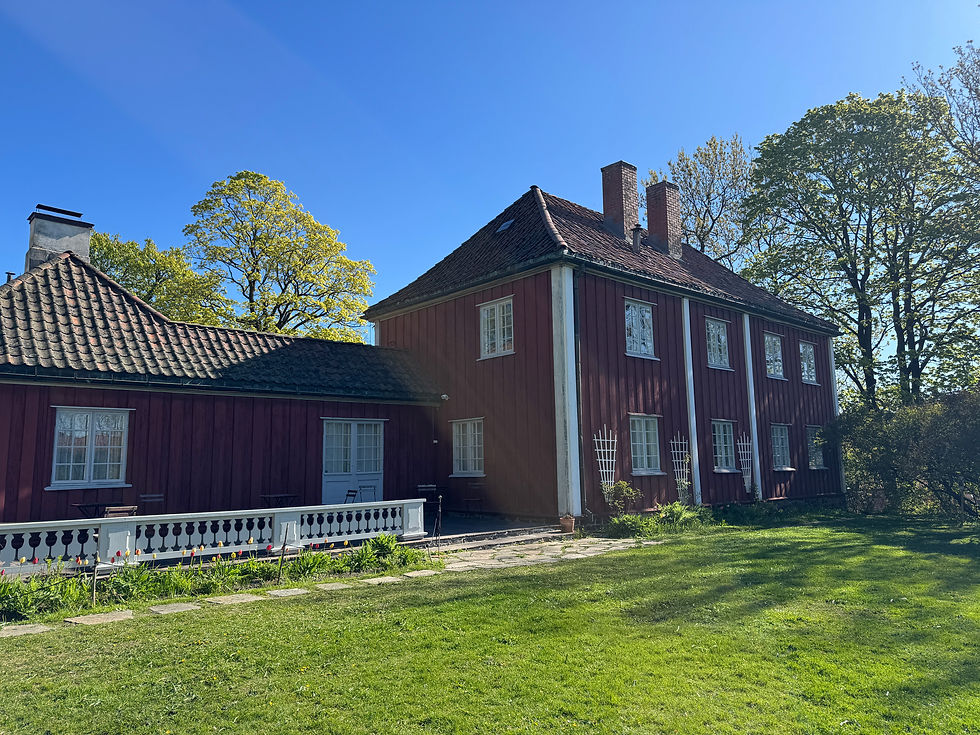
Vøienvolden Gård remains one of the most quietly extraordinary places in the city. Oslo's most complete and best-preserved 18th-century farm cluster — owned by the National Trust of Norway (Fortidsminneforeningen) since 1954 — sits tucked back from Maridalsveien in a courtyard of main house, farmhand quarters, stable, and barn. It is free to visit, open year-round, and the kind of place that makes you stop mid-stride and recalibrate your sense of where you are. A farm, in the middle of Oslo, holding its ground.
Sagene Church still defines the skyline — the great neo-Gothic brick church consecrated in 1891, designed by architect Christian Fürst, that has presided over this neighbourhood through every stage of its history.
How to Spend a Day in Sagene
Start at Mjøl Bakeri for a coffee and a pastry — the pistachio knot is worth the detour. Walk up to Sagene Church and take in the building that anchors the neighbourhood. From there, follow Maridalsveien toward Vøienvolden Gård and step into the farm courtyard.
Head back along the Akerselva river path, past the waterfalls and the old factory buildings. Stop at Hjula Veveri to pick up beers from Sagene Bryggeri. If the season is right, look into Geitmyra — their open days are worth knowing about.
End the afternoon at Rivertz: a glass of something interesting, a piece of art on the wall, and the particular satisfaction of having found a neighbourhood before the world caught up with it. Though at this point, the word is well and truly out.
Explore It With Me
Sagene is the heart of my Hidden Oslo tour — a three-hour walking experience through the industrial heritage and working-class history that shaped modern Norway. It's the Oslo that most visitors never see. In my view, it's the part that explains the city best.
If you'd like to explore it together, you can find details about Hidden Oslo and all my other tours at nordisk-experiences.no.
Rodrigo Braz Vieira is the founder of Nordisk Experiences and a contributing journalist for Time Out Norway. His 2021 article on Sagene contributed to the neighbourhood's inclusion in Time Out's list of the 49 coolest neighbourhoods in the world.


Comments